Hinduism
Varna| The Natural Order We Refuse to Acknowledge
Posted on 4 mins
The traditional varna system has become a convenient target for modern criticism—dismissed as an archaic hierarchy incompatible with democratic values. Yet something curious happens when you observe contemporary society closely: the patterns that varna described haven’t disappeared. They’ve simply gone underground, operating informally while we collectively pretend they don’t exist. What Actually Happens Strip away the rhetoric about equal opportunity and meritocracy, and look at the facts. The child of lawyers becomes a lawyer.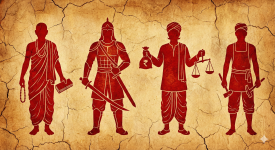
The Kalki Paradox | Divine Intervention and the Pattern of Hindu Resistance
Posted on 9 mins
TLDR - Summary: The Jugantar revolutionary movement in early 20th-century Bengal exemplifies a recurring pattern in Hindu resistance: initial promise grounded in authentic cultural foundations, followed by secular dilution and organizational fragmentation. Founded on Sri Aurobindo’s vision of spiritual nationalism, these gymnasium-based revolutionary cells achieved tactical sophistication—publishing influential newspapers, organizing funding through ideologically-sanctioned robberies, and coordinating international conspiracies—yet ultimately dissolved into the Indian National Congress and various secular political factions.
The Indian Judiciary and Hinduism | Some notable examples of Blatant Bias
Posted on 9 mins
Read the Main Article here - A Comprehensive Indictment of the Anti-Hindu Judiciary of Modern India Judicial Views on Hinduism/Sanatana in India The Indian judiciary’s record on Hinduism and Sanatana Dharma is mixed. Supreme Court benches have often described Hinduism/Hindutva in broad, inclusive terms, but in practice some judges have made controversial remarks or rulings affecting Hindu practices. Critics point to instances of alleged bias or anti-Hindu actions. Below are key examples (with sources) of judges’ statements or rulings relating to Hinduism or religion:
The Indian Judiciary and Hinduism | A Critical Historical Analysis of Colonial Legacy and Contemporary Challenges
Posted on 12 mins
TLDR - Summary: The Systematic Judicial Assault on Sanatan Dharma: Three Centuries of Institutional Colonization This comprehensive analysis exposes the shocking truth: India’s judiciary has operated as an instrument of cultural colonization for over 250 years, systematically dismantling Hindu religious autonomy while masquerading as neutral arbiters of justice. The Colonial Foundation (1757-1947): British rulers didn’t merely govern India—they reconstructed Hindu law itself. Warren Hastings’ “codification” project and the 1864 dismissal of native religious authorities marked the beginning of epistemological warfare against dharmic jurisprudence.
The Great Betrayal | The Death of The Hindu Subcontinent
Posted on 7 mins
Read the Main Article here - How India’s Founding Fathers Murdered a Civilisation For a longer list of some of our most influential founding fathers, with their thoughts and actions for/against hinduism, refer to - A list of the thoughts and actions of some our most influential Founding Fathers The following catalogues major government-led actions, laws or policies (in South and neighboring Asia) widely cited as targeting Hindus. Each item is supported by reliable sources; the focus is on concrete steps (legislation, official decrees, or physical acts by authorities) rather than rhetoric.
The Great Betrayal | A list of the thoughts and actions of some our most influential Founding Fathers
Posted on 31 mins
Read the Main Article here - How India’s Founding Fathers Murdered a Civilisation For a list of actions against the Hindu Society in entire Indian subcontinent, refer to - The Death of The Indian Subcontinent III. Hindu Reformers and Their Vision for Hinduism The 19th and early 20th centuries witnessed a significant wave of Hindu reform movements, driven by a desire to revitalize and redefine Hinduism in response to colonial critiques and internal social challenges.
The Great Betrayal | How India's Founding Fathers Murdered a Civilisation
Posted on 13 mins
TLDR - Summary: The Fundamental Thesis: India’s celebrated “founding fathers” were documented enemies of Hindu civilisation who systematically dismantled millennia-old cultural, legal, and spiritual foundations under the guise of modernisation and secularism. Key Culprits Exposed: Nehru: Self-proclaimed agnostic who declared he “cannot speak for Hindus” while governing them; architected Hindu Code Bills that legally demolished traditional Hindu society Gandhi: Created fraudulent “Sarva Dharma Sama Bhava” concept that imposed Islamic theological framework on Hindu thought; weaponised reform rhetoric to implant civilisational guilt Ambedkar: Openly called Vedas “worthless,” burned Manusmriti, advocated complete destruction of Hindu religious authority, and embedded anti-Hindu principles in the Constitution The Evidence:
The Bengali Paradox | From Hindu Renaissance to Communist Hegemony
Posted on 7 mins
TLDR - Executive Summary: Bengal’s transformation from the epicenter of Hindu nationalist awakening to communist stronghold represents a catastrophic constitutional paradox of civilizational proportions. The very region that produced Bankim Chandra Chatterjee’s Vande Mataram, Aurobindo Ghosh’s revolutionary spirituality, and the Jugantar secret societies—intellectual architects of Hindu constitutional thought—ultimately embraced an ideology fundamentally antithetical to its civilizational foundations. Key Timeline of Events: The Golden Epoch (1838-1920): Bengali intellectuals created sophisticated frameworks fusing Vedantic philosophy with militant nationalism; Chatterjee sanctified motherland-devotion as constitutional principle; Aurobindo transformed spiritual disciplines into revolutionary methodology; secret organizations operated as parallel governmental structures rooted in dharmic principles.
Democracy and Secularism in India | Is it time to Change? Or was it Always Broken...
Posted on 9 mins
TLDR – Summary: India’s secular democracy is critiqued for suppressing Hindu interests and fostering division, with historical evidence and intellectual arguments supporting a shift to a Dharmic governance model that prioritizes duty, justice, and cultural continuity while addressing concerns about majoritarianism. The Mirage of Secular Democracy in India: A Case for a Dharmic Renaissance India’s secular-democratic framework, enshrined in its Constitution since 1950, is often celebrated as a triumph of unity in diversity.