Varna| The Natural Order We Refuse to Acknowledge
Table of Contents
What Actually Happens
Strip away the rhetoric about equal opportunity and meritocracy, and look at the facts. The child of lawyers becomes a lawyer. The child of doctors pursues medicine. Engineers raise engineers. Bankers marry bankers. Professional communities remain largely endogamous, not through formal prohibition, but through natural affinity and practical advantage.
This isn’t accidental. When you grow up in a household where both parents practice law, you absorb the profession’s logic from dinner table conversations, understand its rhythms intuitively, inherit networks and mentorship naturally. No coaching institute can replicate the advantage of breathing a profession’s air from infancy. The entrance examination pretends to create a level playing field, but the child who’s been marinating in medical discourse for eighteen years walks in with advantages that are invisible yet decisive.
We’ve constructed an elaborate system—entrance exams, reservations, coaching industries—all premised on the fiction that occupation and aptitude are independent of family background. Meanwhile, the actual outcomes reveal what we refuse to acknowledge: professions largely run in families, and this pattern exists not because of oppression but because it represents a genuine efficiency in knowledge transmission.
The Original Purpose
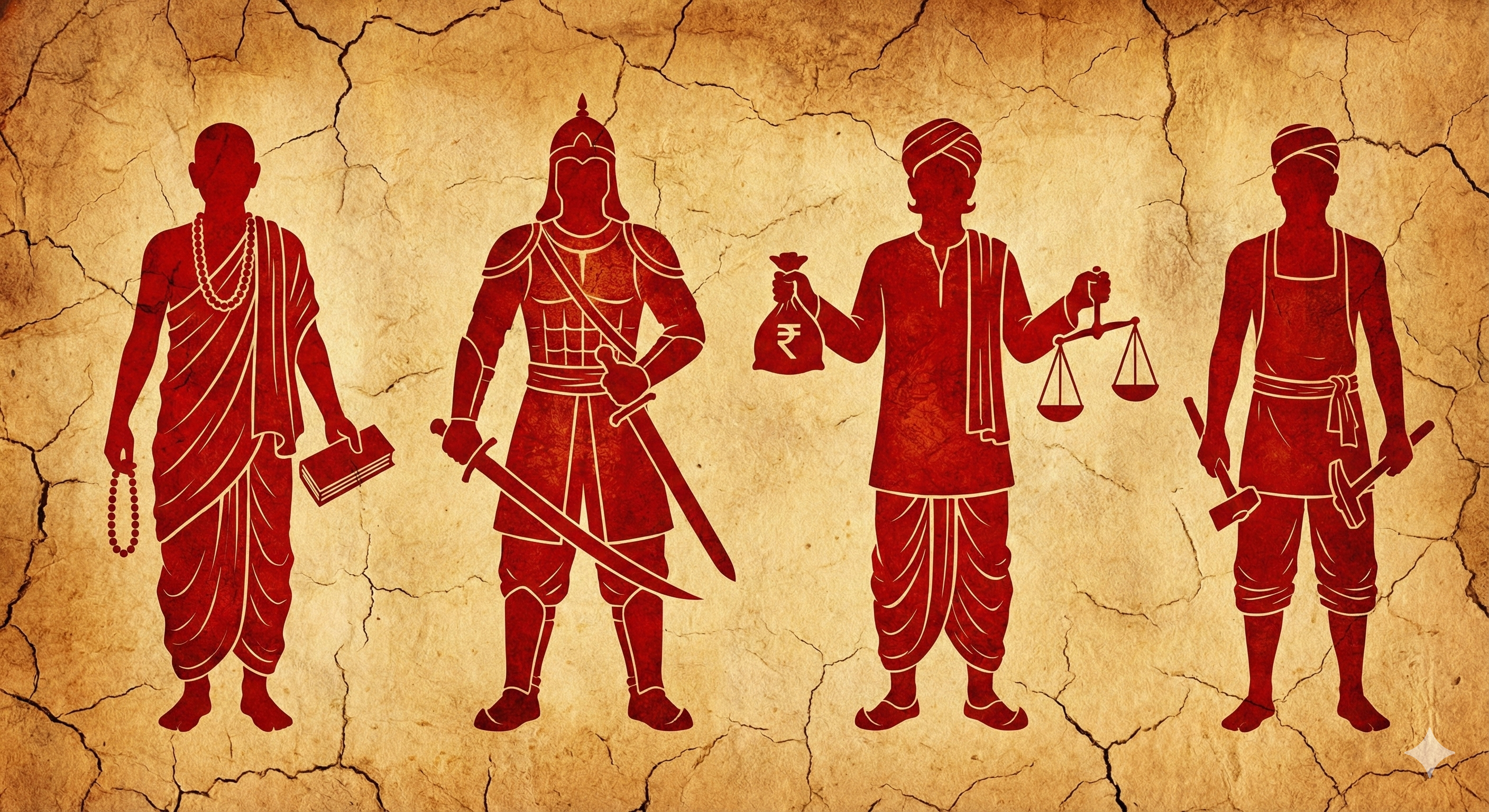
The varna system, properly understood, was never primarily about hierarchy or oppression. Its core function was twofold: preserving hard-won knowledge across generations, and recognizing rather than fighting against natural patterns of human organization.
When expertise must be rediscovered from scratch each generation, civilizational progress stagnates. But when the goldsmith’s child grows up observing techniques from infancy, when understanding is transmitted not just through formal instruction but through years of ambient absorption, mastery compounds. This is why India once produced warriors whose martial traditions influenced fighting systems across Asia, craftsmen who built temples of such intricate complexity that modern engineers struggle to reverse-engineer them, scholars who preserved and elaborated philosophical and mathematical knowledge across millennia.
That excellence didn’t emerge from merit-based selection. It came from lineages and guilds where knowledge accumulated across generations. The skilled artisan’s child became a master artisan not despite being born into that family, but because of it.
The Cost of Denial
Today, that accumulated excellence has largely vanished. The potential master craftsman sits for clerk examinations. Entire traditions of specialized knowledge have been lost because we dismantled the systems that preserved them, replacing them with generic education that prepares everyone for nothing in particular.
We waste enormous collective resources maintaining the pretense. Millions spend years preparing for multiple career paths they’ll never pursue, learning material they’ll never use, competing for positions they’re not suited for—all before typically settling into something close to their family background anyway. The system is dishonest about what it does, inefficient in how it operates, and destructive of the specialized knowledge it claims to value.
Dharma as Natural Law
At its deepest level, varna wasn’t social engineering—it was an acknowledgment of natural patterns. Dharma means living in accordance with the nature of reality itself. When society structures itself against obvious truths—that expertise transmits intergenerationally, that people naturally cluster with those similar to themselves, that excellence requires immersion from youth—it creates friction, waste, and ultimately fails to achieve its stated goals.
The patterns haven’t changed. Children still absorb their parents’ worldview and capabilities. Professional communities still form and perpetuate themselves. Excellence still requires early immersion and sustained mentorship. We’ve simply made these processes informal, unacknowledged, and therefore less effective than they could be.
The Question Worth Asking
The proposal here isn’t to resurrect any particular historical system wholesale. The specific forms that varna took were products of their era, and different ages require different structures. But the underlying observation—that occupational specialization happens naturally and can be organized to preserve and compound knowledge—remains true.
Perhaps the question isn’t whether such patterns should exist. They manifestly do exist, operating right now in every society that claims to have transcended them. The question is whether we’ll continue pretending they don’t exist while stumbling through their chaotic, unregulated manifestation, or whether we’ll acknowledge them openly and consider how they might be structured to maximize human flourishing rather than waste it.
The resistance to even discussing this is revealing. Modern ideology has made certain observations unspeakable, certain patterns undiscussable, regardless of their empirical validity. But dharma—the recognition of natural order—doesn’t require ideological permission. The patterns exist whether we acknowledge them or not.
What India achieved through conscious organization of occupational knowledge is part of the historical record. What we achieve by denying such organization is possible is equally visible. The choice between honest acknowledgment and comfortable fiction remains open, but the longer we wait to think clearly about these patterns, the more human potential we waste in the interim.