Posts
The Machinery of Identity | Why Some Groups Organize Better Than Others
Posted on 15 mins
There’s a persistent puzzle in modern politics that bothers many observers: why do some identity groups seem to have such remarkable cohesion and political effectiveness, while others remain perpetually fragmented? Why do Muslims demonstrate such strong organizational unity across the world? Why have Dalit movements achieved such political potency in India? Why do women’s movements maintain consistent solidarity across different contexts? And conversely, why do Hindus struggle to organize collectively?
The Steel Frame That Never Bent | How Colonial Bureaucracy Became India's Permanent Bottleneck
Posted on 9 mins
When India’s Army Chief recently handed over twenty SUVs to the Sri Lankan military—a gesture saving them millions in rental costs—it prompted a question that echoes across decades of Indian foreign policy: why do we keep doing this? Why does India continue extending goodwill to neighbors with dubious track records of loyalty, repeating patterns that yield little strategic return? The answer, it turns out, isn’t about generosity or naivety.
Varna| The Natural Order We Refuse to Acknowledge
Posted on 4 mins
The traditional varna system has become a convenient target for modern criticism—dismissed as an archaic hierarchy incompatible with democratic values. Yet something curious happens when you observe contemporary society closely: the patterns that varna described haven’t disappeared. They’ve simply gone underground, operating informally while we collectively pretend they don’t exist. What Actually Happens Strip away the rhetoric about equal opportunity and meritocracy, and look at the facts. The child of lawyers becomes a lawyer.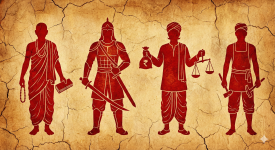
The Rational Apathy | Why India's Borrowed Framework Breeds Dysfunction
Posted on 6 mins
The casual observer might blame India’s civic dysfunction on cultural deficiency or innate selfishness. The streets are filthy, systems are routinely exploited, and apathy seems universal. But this explanation is too convenient—it mistakes symptom for cause. The real answer lies not in the character of Indians, but in the nature of the system they inhabit. The Paradox of Rational Selfishness Consider a simple game theory experiment: two players must independently choose between options A and B.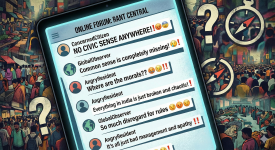
The Performance Problem | On Authenticity and Language in Modern India
Posted on 6 mins
There’s a peculiar phenomenon that runs through the fabric of contemporary Indian society—an overwhelming emphasis on appearance over substance, on the performance of values rather than their practice. From religious observance to professional life, from political discourse to educational pursuits, the culture has become profoundly ornamental. The talk is loud, but the sincerity is thin. The Politics of Symbols Nowhere is this performative tendency more evident than in political discourse.
The Scale Problem | Why Large Democracies Struggle with Social Revolution
Posted on 7 mins
TLDR - Summary: Large democracies face unique challenges that smaller nations avoid. India’s billion-plus population hasn’t created mathematical impossibility of consensus—it has culturally chosen to grant permanent veto power to street protests, making electoral democracy meaningless when any small group can endlessly occupy public spaces without consequence. While America demonstrates that democracies can be agile despite polarization (swinging between extremes every four years), India remains paralyzed by its need to accommodate everyone, ultimately accommodating no one.
The Kalki Paradox | Divine Intervention and the Pattern of Hindu Resistance
Posted on 9 mins
TLDR - Summary: The Jugantar revolutionary movement in early 20th-century Bengal exemplifies a recurring pattern in Hindu resistance: initial promise grounded in authentic cultural foundations, followed by secular dilution and organizational fragmentation. Founded on Sri Aurobindo’s vision of spiritual nationalism, these gymnasium-based revolutionary cells achieved tactical sophistication—publishing influential newspapers, organizing funding through ideologically-sanctioned robberies, and coordinating international conspiracies—yet ultimately dissolved into the Indian National Congress and various secular political factions.
The Indian Judiciary and Hinduism | Some notable examples of Blatant Bias
Posted on 9 mins
Read the Main Article here - A Comprehensive Indictment of the Anti-Hindu Judiciary of Modern India Judicial Views on Hinduism/Sanatana in India The Indian judiciary’s record on Hinduism and Sanatana Dharma is mixed. Supreme Court benches have often described Hinduism/Hindutva in broad, inclusive terms, but in practice some judges have made controversial remarks or rulings affecting Hindu practices. Critics point to instances of alleged bias or anti-Hindu actions. Below are key examples (with sources) of judges’ statements or rulings relating to Hinduism or religion:
The Indian Judiciary and Hinduism | A Critical Historical Analysis of Colonial Legacy and Contemporary Challenges
Posted on 12 mins
TLDR - Summary: The Systematic Judicial Assault on Sanatan Dharma: Three Centuries of Institutional Colonization This comprehensive analysis exposes the shocking truth: India’s judiciary has operated as an instrument of cultural colonization for over 250 years, systematically dismantling Hindu religious autonomy while masquerading as neutral arbiters of justice. The Colonial Foundation (1757-1947): British rulers didn’t merely govern India—they reconstructed Hindu law itself. Warren Hastings’ “codification” project and the 1864 dismissal of native religious authorities marked the beginning of epistemological warfare against dharmic jurisprudence.
The Great Betrayal | The Death of The Hindu Subcontinent
Posted on 7 mins
Read the Main Article here - How India’s Founding Fathers Murdered a Civilisation For a longer list of some of our most influential founding fathers, with their thoughts and actions for/against hinduism, refer to - A list of the thoughts and actions of some our most influential Founding Fathers The following catalogues major government-led actions, laws or policies (in South and neighboring Asia) widely cited as targeting Hindus. Each item is supported by reliable sources; the focus is on concrete steps (legislation, official decrees, or physical acts by authorities) rather than rhetoric.