The Rational Apathy | Why India's Borrowed Framework Breeds Dysfunction
Table of Contents
The Paradox of Rational Selfishness
Consider a simple game theory experiment: two players must independently choose between options A and B. If both choose B, each gets 3 points. If one chooses A and the other B, the A-player gets 5 points while the B-player gets nothing. If both choose A, both get zero. When players can discuss strategy beforehand, most choose mutual cooperation (B). When they cannot, they’re far more likely to betray each other, both ending up with nothing.
The lesson is clear: cooperative behavior emerges from certainty and trust in systems. When guarantees vanish, selfishness becomes rational—not stupid, but adaptive. Local optimization replaces global optimization when you cannot trust the broader system to reward your investment in the collective good.
This is the fundamental dynamic of contemporary India. The chaos isn’t a moral failing—it’s an economically rational response to systematic uncertainty.
The Absent State and the Survival Response
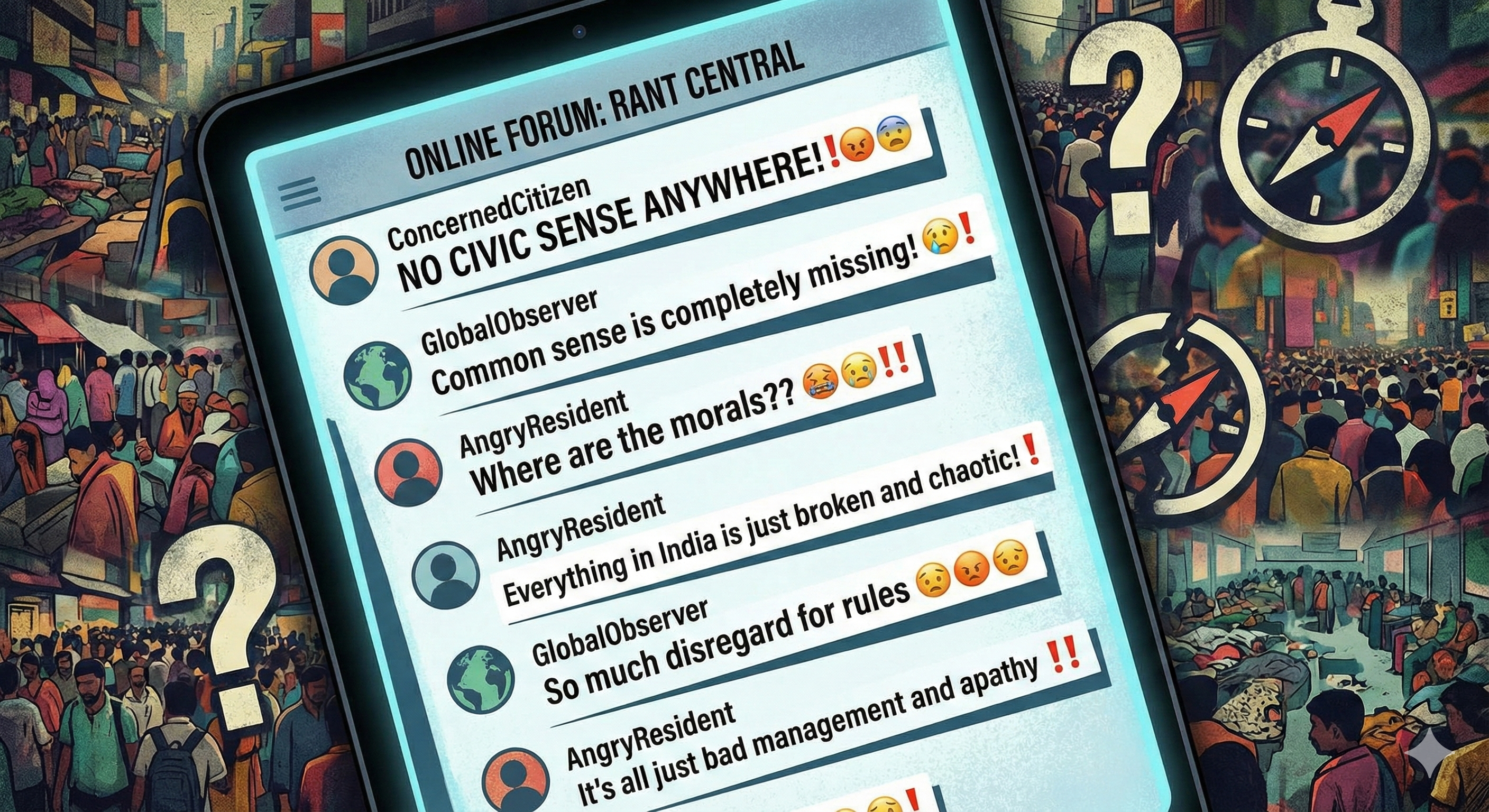
India’s civic landscape presents as pure entropy. Roads lack proper structure, dotted with potholes, protruding electrical poles, vendor carts, and open drains. Garbage collection schemes are either absent or unreliable. Animals roam freely. Even in major cities, basic infrastructure is either missing or dysfunctional. For a pedestrian, simply walking requires constant navigation of obstacles—it’s not about population density (Tokyo has higher density without this chaos), but about the complete absence of order.
When the state is functionally absent and systems are unreliable, individuals adapt. They stop caring about collective welfare because no one can guarantee that their good behavior will be reciprocated or rewarded. Consider garbage disposal: people litter because the system makes proper disposal visibly pointless. Public dustbins overflow and never get cleared. Well-managed spaces stay clean while poorly managed properties become dumping grounds, because that becomes the observable norm. When you can see that your effort to find a dustbin and dispose properly will have zero systemic effect, doing so becomes irrational. Why follow traffic rules when they’re arbitrarily enforced? Why invest in long-term collective goods when short-term exploitation is the only reliable strategy?
This apathy isn’t psychological weakness—it’s a survival mechanism. When every interaction is potentially adversarial and every system potentially corrupt, detachment becomes necessary. The alternative is constant disappointment and exploitation.
The Root: A Framework Without Context
The deeper question is: why does India lack functional systems? The answer lies in the country’s constitutional framework itself—approximately 90% derived from the Government of India Act of 1935, with minimal substantive changes.
India adopted Western liberal democratic structures wholesale, without the cultural and historical context that makes them coherent. The result is a system that operates on borrowed slogans rather than understood principles.
Take secularism. In Europe, secularism emerged from specific historical circumstances—the religious wars, the relationship between church and state, the nature of Christianity as a proselytizing religion. Europeans understand the background; their courts can rule coherently on religious matters because they grasp the principle’s origins and purposes.
India imported the term without its context. Courts attempted to separate “secular” from “religious” practices by identifying “essential practices” in Hinduism, demanding textual proof of what’s essential. When Hindus disagreed among themselves, courts assumed the authority to interpret religious texts and decide what was truly essential versus later corruption. This would be unthinkable in Europe—imagine a court telling Christians what’s genuinely Christian—but it proceeds in India because secularism exists as a slogan, not an understood framework.
Similarly, the right to proselytize is considered sacred to religious freedom in these borrowed frameworks because it’s essential to Christianity. But Hinduism isn’t a proselytizing tradition. For Hindu society, the “right to be left alone” would be equally valid—yet this principle doesn’t exist in the imported legal structure because it wasn’t needed in the Christian societies that developed these frameworks.
A Country Fitting Itself to Laws
The critical inversion is this: India is attempting to fit itself under foreign laws rather than building laws to govern itself. The process is backwards. Every principle operates as a slogan without deep understanding, leading to endless negotiation. There’s no unshakeable moral standing because everything was borrowed without proper grounding.
This manifests everywhere. Traffic police accept 500 rupees. Magistrates accept 10 lakhs. Every law is negotiable because the system itself lacks coherent principles. The entire country operates as an endless negotiation because the constitutional framework provides no firm foundation.
Students cheat not because they’re immoral, but because there’s no guarantee that honest effort will be rewarded. Citizens exploit systems not because they’re inherently selfish, but because acting otherwise would be economically irrational. The system’s structure—or lack thereof—makes exploitation the smart play.
The Question That Remains
Why did India, unlike other civilizational states, accept this wholesale importation? China adapted communism to Chinese characteristics. Russia never truly accepted democracy, maintaining a need for czar-like figures from the Tsars to the Commissars to Putin. Japan refused to compromise its core traditions. Even France, despite its contradictions, maintains coherent positions like banning burqas.
But India accepted everything, operating on borrowed frameworks without the context that makes them functional. The country with thousands of years of civilizational continuity somehow allowed itself to be governed by principles designed for entirely different societies.
This remains the question of the century: what historical process led to such wholesale acceptance? The answer likely requires deep comparative study of democracies, colonial legacies, and the specific dynamics of Indian independence movements.
Moving Forward
For now, the hypothesis stands: India’s dysfunction stems from a constitutional framework borrowed without context, creating systematic uncertainty that makes selfish behavior rational and apathy adaptive. The solution isn’t moral reform or cultural change—it’s institutional redesign that creates genuine certainty, where cooperative behavior becomes the rational choice because the system reliably rewards it.
Until then, the chaos will persist. Not because Indians are uniquely flawed, but because they’re rationally responding to a uniquely incoherent system. The trash in every corner reflects the borrowed principles in every law—out of place, unintegrated, and ultimately dysfunctional.
What India needs isn’t better people. It needs a system built for its own society, not one copy-pasted from Christian Europe. That’s the fundamental reform that must precede all others.