Posts
Same System, Same Result
Posted on 4 mins
Rule-bending in India is usually explained as a cultural legacy of colonial rule or as a heritable trait. A simpler account fits the evidence better. The colonial system was inherited largely intact and still enforces its rules weakly, so the same behaviour stays rational for the same reasons today. The claim Queues dissolve, contracts lean on personal ties, and rules are treated as suggestions. The usual explanation points to jugaad, the workaround as cleverness, and izzat, status that supposedly falls when you follow a rule that benefits only others.
The Lion's Tongue
Posted on 11 mins
TLDR - Summary: खड्गजिह्व धनुरास्यं शरदंष्ट्रं तरस्विनम् । दृप्तं पुरुषशार्दूलं जहि कर्ण धनंजय ।। Karna is a lion among men — his tongue a blade, his open mouth a bow, his teeth like arrows; swift, and proud beyond measure. Strike him down, Arjuna. — Mahabharata, Karna Parva Popular memory has been kind to Karna in a way the Mahabharata itself never quite is. In the epic’s afterlife — in television serials, devotional retellings, and the general drift of sympathetic reinterpretation — he has become something close to a tragic hero: a man of low birth mocked by an unjust order, loyal to a fault, cursed by circumstance rather than choice.
The Vanishing Guru: On Diagnosis, Discipline, and the Price of Real Learning
Posted on 6 mins
TLDR - Summary: Self-directed learning has a blind spot: a mind cannot fully catalogue its own ignorance. A student can work through every previous year’s paper and finish an entire test series, and still meet, on exam day, a question that answers to nothing he prepared for — not because the syllabus was hidden from him, but because self-assessment cannot see past itself. One only revises for gaps one already knows about.
A System That Shouldn't Work — And Doesn't
Posted on 3 mins
TLDR - Summary: A typical public-sector role pays a fixed salary, is nearly impossible to lose once confirmed, promotes by seniority, and has no equivalent of profit to measure performance against. Predict what a rational person does inside that structure, and the answer is: as little as possible. That is not a character flaw. It is what the incentives specify. The issue Corruption is usually treated as a shortage of honest people.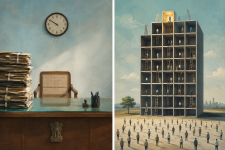
Too Many Hands, Too Few Occupations
Posted on 10 mins
TLDR - Summary: India’s chronic complaint is not a shortage of people willing to work. If anything, the evidence points the other way. Every year, men leave for construction sites in the Gulf, queue outside recruitment agents for a berth on an oil rig, or cross state lines for jobs that carry no particular dignity, only a wage. There is no shortage of appetite for hard, low-status labour when the money is real, however small.
Learning Nothing, Losing More
Posted on 8 mins
Every year, India’s big IT services firms put tens of thousands of new hires through six to ten weeks of training before letting them near a real project. The syllabus tries to cover everything — a messaging platform this week, a data warehousing tool the next, a bit of machine learning thrown in somewhere — and covers none of it well. Ask anyone who’s been through it what they actually remember, and the answer is usually: not much.
The Unwritten Rule
Posted on 11 mins
I. A Puzzle of Survival Every other major polytheism the ancient world produced is now, in the fullest sense, gone. No one prays to Amun-Ra expecting the Nile to flood on schedule. No one leaves offerings for Odin before a crossing. The gods of Athens and Rome survive only as literature, marble, and metaphor. In each case, a monotheistic tradition arrived, organized itself, and displaced what came before, not through gradual attrition but through something closer to a systematic institutional campaign.
The Arithmetic of Mobilization
Posted on 11 mins
Reservation in India was supposed to be temporary. That was the promise — a brief constitutional correction, a decade-long transition to lift the historically marginalized, after which the Republic would move toward equal citizenship. Seven decades later, the transition has not ended. It has expanded. The question of why it endures is usually answered with moral arguments — about justice, historical suffering, social equity. These are the terms the debate is conducted in.
लामबंदी का अंकगणित
Posted on 12 mins
लोकतंत्र के बारे में एक आरामदायक कल्पना है — कि यह विचारों का बाज़ार है, जहाँ सबसे तर्कसंगत तर्क जीतता है, जहाँ नागरिक साक्ष्यों को तौलते हैं और सैद्धांतिक स्थितियों पर पहुँचते हैं। यह एक चापलूसी भरा चित्र है। यह लगभग पूरी तरह से गलत भी है। लोकतंत्र तर्क पर नहीं चलता। यह आम सहमति पर चलता है। और आम सहमति के लिए सही होना ज़रूरी नहीं है। इसके लिए संगठित होना ज़रूरी है।
On Shuddhi, Varna, and the Goal of Becoming Brahman
Posted on 7 mins
There is a phenomenon almost everyone has experienced but few have named cleanly. Spend five hours in an environment of pure stimulus — surrounded by people who react rather than reflect, who operate on appetite rather than thought — and you return from it diminished. Not tired, not bored, but degraded in some specific way. The texture of your thinking coarsens. The reflective life recedes. You feel, to put it plainly, more animal.